Narrative Strategy
Economic change does not scale on evidence alone. It scales when people share a common language, a shared frame, and a compelling story about what is possible.
My narrative strategy work focuses on strengthening the ecosystem advancing economic mobility, particularly through employee ownership and job quality.
I do this by aligning messaging, amplifying primary sources, and building shared narrative infrastructure across institutions and regions.
This work sits at the intersection of strategy and storytelling. It is about shaping how ideas travel, how we share ownership of the stories that make us, and how movements gain momentum.
Public Engagement & Media
Dialogue to Awaken the Ownership Economy
Selected Work
Listen
Learn
Engage
The Ownership Economy Field Brief
The Ownership Economy Field Brief was developed to articulate a coherent frame for advancing employee ownership as part of a broader ownership economy narrative. It connects ownership transitions, job quality, capital access, and regional economic strategy into a shared language that practitioners, funders, and policymakers can act on.
The brief is designed to support alignment across institutions while strengthening public understanding of ownership as an economic development strategy.
From Paychecks to Profits: How Employee Ownership Drives Equity
with Krisi Schell and Tom Strong on State of Our Workforce Podcast by National Fund for Workforce Solutions.
Building New Narratives on Work and Opportunity in the US South
with Shuh-Marraka Johnson, Dom Kelly, Alexis Tsoukalas and Matt Helmer in the Job Quality in Practice series by The Aspen Institute’s Economic Opportunities Program.
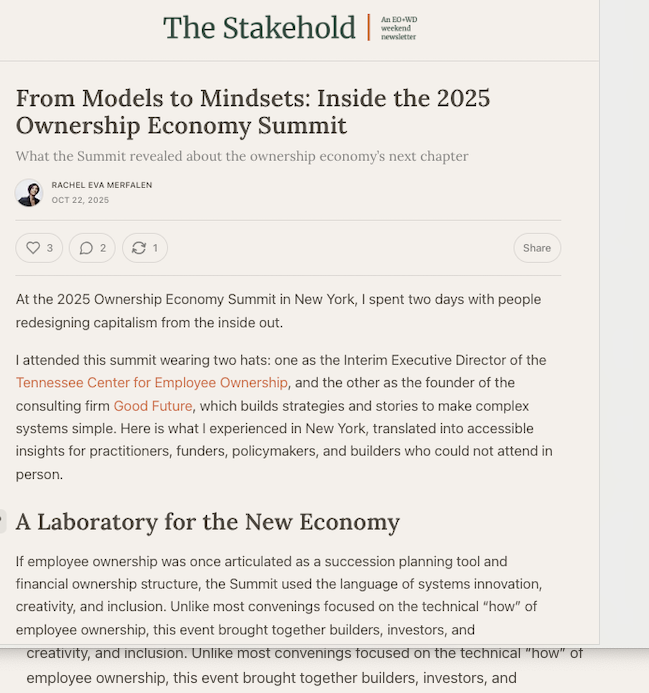
Read the “Brief in Brief” at The Stakehold

Narrative is infrastructure
Narrative is not an accessory to policy or program design. It is infrastructure. The language we use, the stories we elevate, and the frames we reinforce determine whether promising models remain niche or become normalized.
Connect
Reach out to explore narrative partnerships.
Feel free to book a call below, or connect on LinkedIn to chat about podcasts, speaking engagements, or collaborations.